

Quick Answer
Concrete steps crack in Toronto homes due to freeze-thaw cycles, poor drainage, soil movement, inadequate base preparation, de-icing salt, age, water pooling, and settlement beneath the steps. Small surface cracks may only need monitoring or repair, but wide cracks, sinking, separation from the home, loose edges, or uneven step heights can become safety concerns. The cause of the cracking matters because patching the surface will not last if water, movement, or underlying problems remain active.
Concrete steps are exposed to some of the hardest conditions around a Toronto home. They take foot traffic, rain, snow, ice, salt, roof runoff, ground movement, and repeated temperature swings. Over time, even strong concrete can crack if water gets into small openings or if the base underneath the steps starts to move.
For homeowners, the first question is usually simple: Is this crack normal, or does it mean the steps need repair? The answer depends on the crack pattern, the step movement, the drainage in the area, and whether the damage is worsening.
This guide explains why concrete steps crack in Toronto homes, what warning signs to watch for, when repair may be enough, when replacement may be the better choice, and what homeowners can safely check before calling a mason.
Why Concrete Step Cracks Are Common in Toronto
Concrete step cracks are common in Toronto because exterior steps are exposed to moisture, freezing weather, salt, snow removal, and ground movement. These conditions can stress concrete from both above and below.
Toronto homes often have older front steps, basement entrance steps, side-yard steps, porch steps, and walkway transitions that have been exposed for many years. Some were built on a strong base. Others may have a weak base, poor drainage, older patching, or soil that has shifted over time.
The City of Toronto’s basement flooding guidance identifies poor lot grading, drainage problems, overflowing eavestroughs, and leaking or plugged downspouts as common water concerns around homes. These same water patterns can also affect concrete steps when water is directed toward the base, sits on the surface, or freezes in cracks.
Safety also matters. Concrete steps are walking surfaces, so uneven treads, loose edges, ice buildup, and cracks can increase the risk of slips and trips. The Canadian Centre for Occupational Health and Safety explains that slips, trips, and falls are often linked to walking-surface conditions, poor traction, and uncorrected hazards. Homeowners do not need workplace rules for their front steps, but the safety principle is still useful: damaged walking surfaces should not be ignored.
Common Signs Your Concrete Steps Are Cracking for a Reason
Concrete steps often give warning signs before the damage becomes serious. A hairline crack may not be urgent, but cracking combined with movement, water, or surface breakdown deserves closer attention.
Watch for these signs:
- Hairline cracks across the step surface.
- Wide cracks that continue to grow.
- Step edges that chip, crumble, or break away.
- Concrete flakes or rough surface scaling.
- Steps separating from the porch, walkway, or foundation.
- Sinking, tilting, or uneven step heights.
- Water pooling on the tread or at the base.
- Rust stains from exposed metal reinforcement.
- Loose patches from previous repairs.
- Cracks that worsen after winter.
- Ice is forming repeatedly in the same low spot.
The more signs you see together, the more likely the cracking is connected to a deeper issue. For example, one shallow surface crack may be minor. A cracked step that is also sinking, holding water, and separating from the porch is more serious.
Cause 1: Freeze-Thaw Cycles
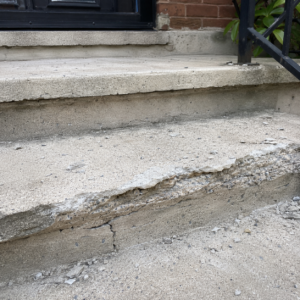
Freeze-thaw cycles are one of the biggest reasons concrete steps crack in Toronto. Water enters small cracks, pores, joints, or surface defects. When the temperature drops, the water freezes and expands. When it thaws, more water can enter again.
This repeated expansion and contraction can widen cracks, break step edges, loosen old patches, and cause surface scaling. The problem often becomes more visible in spring because the damage accumulates over winter.
Freeze-thaw damage is more likely when:
- Steps hold water rather than shed it.
- Cracks are left open before winter.
- Surface concrete is already worn or porous.
- Salt is used heavily on the steps.
- Snow piles against the step face or side walls.
- Downspouts or roof runoff send extra water toward the steps.
Freeze-thaw damage does not always mean the steps need to be fully replaced. But if the surface keeps breaking apart every winter, the repair should address water movement and surface condition, not only the visible crack.
Cause 2: Poor Drainage Around the Steps
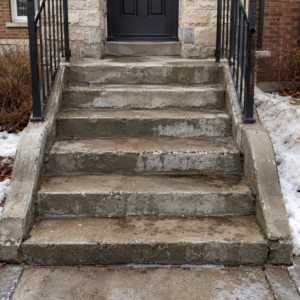
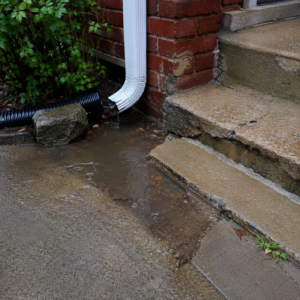
Poor drainage causes concrete steps to crack by keeping water on, under, or beside the steps. Concrete can handle some moisture, but repeated water exposure can cause problems when it freezes, seeps into cracks, or softens the base beneath.
Drainage problems may come from:
- Downspouts are discharging near the steps.
- Walkways or landings sloping toward the steps.
- Water is pooling at the bottom step.
- Soil or garden beds holding moisture against the side of the steps.
- Clogged eavestroughs are overflowing near the entrance.
- Low spots where snowmelt collects.
- Basement stairwells or side entrances with poor drainage.
If drainage is the cause, patching the concrete may only be a short-term fix. The water path should be corrected so the steps can dry properly. If nearby foundation moisture is also a concern, Otto’s Masonry’s basement waterproofing Toronto page may help homeowners understand how drainage, foundation protection, and exterior masonry issues can connect.
Cause 3: Soil Movement and Settlement
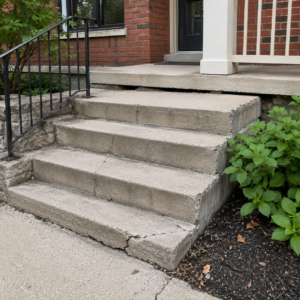
Soil movement can crack concrete steps when the soil beneath them shifts, settles, expands, or washes out. Concrete is strong, but it does not bend well. If the ground below it moves unevenly, the concrete can crack.
Settlement may happen because of:
- Poor base preparation during the original installation.
- Soil washout from water running under the steps.
- Clay-heavy soil that expands and contracts with moisture.
- Freeze-thaw movement below the steps.
- Old fill material that was not compacted properly.
- Tree roots are disturbing the nearby soil.
- Water from downspouts or poor grading softens the ground.
Settlement cracks are often more serious than simple surface cracks. If one side of the steps is lower than the other, if the steps pull away from the home, or if the walkway no longer lines up, the issue may be below the concrete rather than only on the surface.
Cause 4: De-Icing Salt and Winter Wear
De-icing salt can worsen damage to concrete steps, especially when the concrete is already cracked, porous, young, or poorly sealed. Salt helps melt ice, but it also increases moisture movement and can contribute to scaling, flaking, and surface breakdown.
Toronto homeowners often use salt for safety, especially on front steps and walkways. The problem is overuse. Heavy salt exposure can leave the step surface rough, pitted, and more prone to water penetration.
Salt-related damage often appears as:
- Flaking or peeling surface concrete.
- Rough, sandy, or pitted areas.
- White residue after snowmelt.
- Chipped step edges.
- Surface scaling that worsens every spring.
Homeowners still need to manage ice safely. The better approach is to use de-icing products carefully, remove snow early, avoid piling salty slush against concrete, and repair open cracks before water and salt can enter deeper.
Cause 5: Weak Base or Poor Original Installation
A weak base can cause concrete steps to crack even if the concrete itself was mixed properly. Steps need stable support below them. If the base was not compacted well, lacks proper drainage, or sits on unstable soil, cracks may appear as the steps settle.
Installation-related cracking may show up as:
- Cracks across the full width of the steps.
- One side is sinking more than the other.
- Separation between steps and the porch or walkway.
- Repeated patch failure in the same area.
- Uneven risers or treads.
- Water is pooling because the steps no longer slope properly.
Older Toronto homes may have steps that were repaired several times without the base ever being corrected. If that is the case, a surface patch may fail because the underlying support is still moving.
Cause 6: Age, Wear, and Old Repairs
Concrete steps can crack simply because they have aged over the years of use and exposure to weather. Over time, surface wear, small cracks, old patches, and moisture exposure can combine to cause greater damage.
Old repairs can also create weak points. A patch that was not properly bonded, applied over loose concrete, or installed without correcting drainage issues may break away. If several patch layers are visible, the steps may have a longer history of cracking than the surface first suggests.
Age-related damage may still be repairable if the structure is stable. But if the steps are badly cracked, crumbling, sinking, or unsafe, replacement may be the better long-term choice.
Repair Options for Cracked Concrete Steps
The right repair depends on the depth of the cracks, the condition of the base, drainage, safety, and whether the steps are moving. Some cracks can be repaired. Others suggest the steps need partial rebuilding or full replacement.
Common repair options include:
- Crack repair: Used for limited cracks in stable, non-moving concrete.
- Edge repair: Used when corners or nosings are chipped but the step remains solid.
- Surface patching: Used for shallow damage when loose material is removed, and the base is sound.
- Resurfacing: Used when the surface is worn but the steps are structurally stable.
- Drainage correction: Used when water is causing repeated cracking or surface damage.
- Step rebuilding: Used when parts of the steps are failing, but the full structure does not need to be replaced.
- Full replacement: Used when the steps are sinking, separating, badly cracked, unsafe, or built on a failing base.
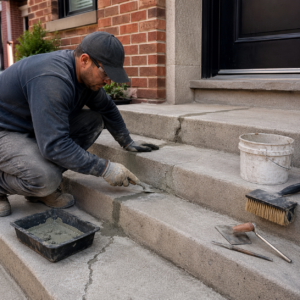
Otto’s Masonry provides concrete repair in Toronto for cracked, uneven, sunken, and deteriorated concrete around homes, including concrete steps, porches, walkways, driveways, slabs, and exterior concrete surfaces. If you are comparing repair and replacement, Otto’s guide on concrete step repair vs replacement in Toronto is also a useful companion resource.
When Concrete Step Repair May Be Enough
Concrete step repair may be enough when the cracks are shallow, the steps are stable, and the problem is not caused by major settlement or drainage failure. In these cases, repair can improve safety, appearance, and water resistance.
Repair may be suitable when:
- Cracks are narrow and not spreading quickly.
- The steps are not sinking or tilting.
- The surface damage is limited to small areas.
- Edges are chipped, but the step body is solid.
- Water is not pooling heavily on or under the steps.
- The repair area can be properly cleaned and prepared.
- There is no major separation from the home or walkway.
For example, a few small edge chips or shallow cracks may be repairable if the steps are still level and draining properly. The repair should still be done carefully because poor patching can fail after one winter.
When Replacement May Be the Better Choice
Replacement may be the better choice when concrete steps are badly cracked, uneven, sinking, separating, or unsafe. In these cases, the issue is often deeper than the visible surface.
Replacement may be needed when:
- Cracks are wide, deep, or running through several sections.
- The steps are sinking, tilting, or pulling away from the home.
- Risers or treads are uneven enough to affect safe use.
- Large sections are crumbling or breaking apart.
- Water keeps pooling because the steps no longer slope correctly.
- Old repairs keep failing in the same areas.
- The base below the steps is unstable.
- Metal reinforcement is exposed or rusting.
Replacement should not only recreate the same problem. If the old steps failed because of poor drainage or base movement, those issues should be corrected as part of the new work. Otherwise, new concrete can eventually crack for the same reason.
What Homeowners Can Safely Check Themselves
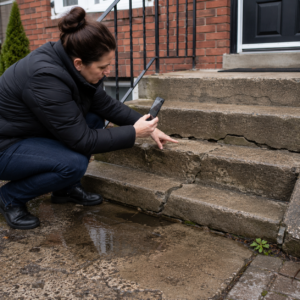
Homeowners can safely do a visual check of concrete steps from ground level. The goal is to spot cracking patterns, movement, water problems, and safety concerns before deciding whether to request a repair estimate.
Check these items:
- Look for cracks that are widening or spreading.
- Check whether any step feels loose, uneven, or unstable.
- Look for water pooling on the tread or at the bottom step.
- Check whether downspouts or roof edges send water toward the steps.
- Look for surface scaling, flaking, or salt damage.
- Check whether the steps are separated from the porch, walkway, or foundation.
- Take photos after winter and compare them with those taken after heavy rain.
- Note whether patches have failed in the same area before.
Avoid hammering loose concrete, lifting sections, or trying to grind cracks if you are not sure what is causing the damage. If the steps are unstable, slippery, or uneven, limit use where possible until they are assessed.
When to Call a Mason
You should call a mason when concrete step cracks are spreading, the steps are uneven, water is pooling, edges are crumbling, patches keep failing, or the steps are separating from nearby surfaces. These signs suggest the problem may involve drainage, movement, or deeper concrete deterioration.
Call sooner if the steps are used daily, if children or older adults use them, if the damage creates a trip hazard, or if the steps are part of a main entrance. Exterior steps are not just cosmetic. They affect safe access to the home.
Otto’s Masonry provides masonry services in Toronto, including concrete repair, concrete steps and porches, brick repair, stone masonry, parging, retaining walls, interlocking, and basement waterproofing. If cracked concrete steps connect to a walkway, paver area, or entrance redesign, Otto’s interlocking Toronto page may also be useful for understanding outdoor surface options around the steps.
FAQs About Cracked Concrete Steps in Toronto
Why do concrete steps crack in Toronto?
Concrete steps crack in Toronto due to freeze-thaw cycles, poor drainage, soil movement, inadequate base preparation, de-icing salt, age, water pooling, and settlement beneath the steps.
Are small cracks in concrete steps serious?
Small cracks are not always serious if the steps are stable and the cracks are not spreading. They should still be monitored because water can enter small cracks, worsening them during winter.
Can cracked concrete steps be repaired?
Yes, cracked concrete steps can often be repaired when the damage is limited, and the steps are not sinking, separating, or badly deteriorated. If the base is moving, the repair may not last unless the cause is corrected.
When should concrete steps be replaced instead of repaired?
Concrete steps may need replacement when they are sinking, tilting, separating from the home, badly cracked, crumbling, holding water, or unsafe to walk on.
Does salt make concrete step cracks worse?
Salt can make concrete damage worse by increasing moisture exposure and surface breakdown, especially when concrete is already cracked or worn. Heavy salt use can contribute to scaling and flaking.
Can poor drainage cause cracks in concrete steps?
Yes. Poor drainage can keep water on or under the steps. When that water freezes or weakens the base, cracks, settlement, and surface damage can develop.
Should I repair concrete steps before winter?
If cracks are open, edges are loose, water pools on the steps, or the surface is deteriorating, it is better to have the steps checked before winter. Freeze-thaw cycles can worsen existing damage.
Final Answer
Concrete steps crack in Toronto homes because of moisture, freeze-thaw cycles, drainage problems, salt exposure, soil movement, weak base support, age, and repeated winter wear. The visible crack is often only part of the issue, so the cause should be checked before choosing a repair.
Small stable cracks may be repairable, but sinking, uneven, separating, crumbling, or water-holding steps may need a larger fix or replacement. The safest approach is to look at both the concrete surface and what is happening around and underneath the steps.