

Quick Answer
Concrete step repair may be enough when the damage is minor, stable, and mostly limited to cracks, chipped edges, surface wear, or small repairable areas. Replacement is usually the better choice when the steps are sinking, tilting, separating from the home, badly crumbling, structurally weak, or creating safety hazards. In Toronto, the decision often depends on freeze-thaw damage, drainage, salt exposure, base movement, and whether the existing steps can still support safe daily use.
Concrete steps take a lot of abuse around Toronto homes. They deal with rain, snow, ice, salt, foot traffic, shifting soil, and repeated freeze-thaw cycles. Over time, even well-built steps can crack, chip, settle, or wear down.
The hard part is deciding whether concrete step repair is enough or whether replacement is the smarter long-term choice. A small crack, chipped corner, or worn surface may be repairable. But steps that are moving, hollow, badly uneven, or falling apart may keep failing no matter how many times the surface is patched.
This guide explains how to compare concrete step repair vs replacement in Toronto, what signs to look for, what repair options may help, and when a larger rebuild is the safer and more practical decision.
Why Concrete Step Damage Is Common in Toronto
Concrete step damage is common in Toronto because exterior steps are exposed to moisture, ice, salt, temperature swings, and ground movement. These conditions can damage the surface and the base underneath.
Many Toronto homes have front steps, porch steps, side entrance steps, basement walkout steps, and back entrance steps that are decades old. Some steps were installed with a strong base and proper drainage. Others may have been patched several times, poured over weak material, or built in a way that now allows water to collect.
Water is often the biggest factor. When water enters cracks or collects near the base of the steps, freezing temperatures can worsen the damage. The City of Toronto’s basement flooding guidance identifies poor lot grading, drainage problems, overflowing eavestroughs, and leaking or plugged downspouts as common water concerns around homes. Those same water patterns can also affect concrete steps and entrance areas.
Safety also matters. The Canadian Centre for Occupational Health and Safety explains that slips, trips, and falls are often connected to walking-surface hazards. While that guidance is written for workplace safety, the practical idea applies to home entrances too: cracked, uneven, slippery, or crumbling steps should be corrected before they become a daily hazard.
Common Signs Your Concrete Steps Need Attention
Concrete steps need attention when cracks, movement, surface wear, water pooling, or loose edges affect safety, drainage, or long-term durability. Not every crack means replacement, but damage should be judged by both appearance and stability.
Watch for these signs:
- Hairline cracks across the tread, riser, or side.
- Wide cracks that continue to grow.
- Chipped or broken step edges.
- Surface scaling, flaking, or pitting.
- Loose or crumbling concrete pieces.
- Steps that feel uneven, hollow, or unstable.
- Steps separating from the porch, landing, walkway, or foundation.
- Water is pooling on the step surface or at the base.
- Ice is forming repeatedly in the same low spot.
- Old patches that are lifting, cracking, or falling away.
- Rust staining or exposed metal reinforcement.
The more signs that appear together, the more carefully the steps should be assessed. A narrow surface crack is very different from a cracked step that is also sinking, holding water, and pulling away from the house.
When Concrete Step Repair May Be Enough
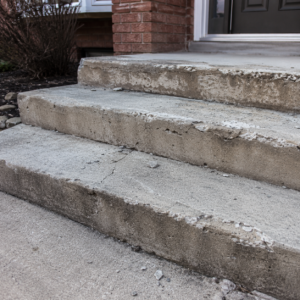
Concrete step repair may be enough when the steps are still stable and the damage is limited. The repair should improve safety, prevent further water entry into the concrete, and correct small problem areas before they spread.
Repair may be suitable when:
- Cracks are narrow and not spreading quickly.
- The steps are not sinking, tilting, or separating.
- Damage is mostly surface-level.
- Only a few edges or corners are chipped.
- The step body is still solid.
- Water is not heavily pooling on or under the steps.
- Old patches can be removed and properly prepared.
- The repair will not create a new trip hazard.
For example, a front step with a few chipped edges and shallow cracks may only need edge repair, crack repair, surface preparation, and improved drainage. If the structure below the surface is still sound, a full entrance replacement may not be necessary.
Otto’s Masonry provides concrete repair in Toronto for cracked, uneven, sunken, and deteriorated concrete around homes, including concrete steps, porches, walkways, slabs, and entrance areas.
When Concrete Step Replacement Is the Better Choice
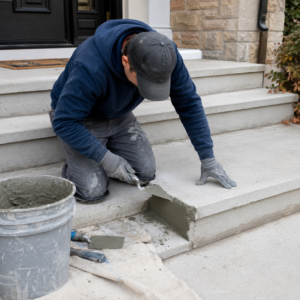
Concrete step replacement is usually the better choice when the damage is structural, widespread, unsafe, or caused by base movement. In these cases, patching the surface may only hide the problem for a short time.
Replacement may be the smarter option when:
- The steps are sinking or tilting.
- The steps are pulling away from the home, porch, or walkway.
- Several treads or risers are uneven.
- Large sections are crumbling or breaking apart.
- Cracks run deeply through multiple sections.
- The surface has been patched many times and keeps failing.
- The base below the steps has shifted or washed out.
- Water continues pooling because the steps no longer slope properly.
- The entrance feels unsafe for regular use.
Replacement should solve more than the visible damage. If the original steps failed due to poor drainage, inadequate base preparation, or soil movement, the new work should address those conditions. Otherwise, new concrete can eventually crack or settle for the same reason.
What Causes Concrete Step Repairs to Fail?
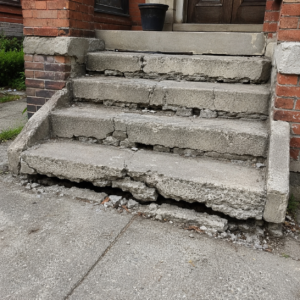
Concrete step repairs usually fail when the cause of the damage is not corrected. A patch can only last if the surface is properly prepared and the step beneath is stable.
Common reasons repairs fail include:
- Water keeps entering the crack or joint.
- The step is still moving or settling.
- Loose concrete was not removed before patching.
- The repair material was applied too thinly or poorly bonded.
- Drainage still sends water toward the steps.
- Salt and freeze-thaw cycles attack the same weak area.
- The old concrete is too deteriorated to hold a surface repair.
- The repair creates a raised edge that becomes a trip hazard.
This is why comparing repair and replacement should start with the cause. If the concrete is stable and the problem is local, repair may work. If the step is moving or the base has failed, replacement may save money and frustration over time.
How Toronto Weather Affects the Decision
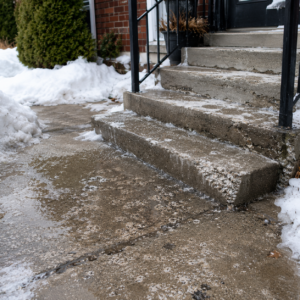
Toronto weather affects the repair-versus-replacement decision because exterior concrete is constantly exposed to moisture and temperature fluctuations. Freeze-thaw cycles can enlarge a small crack if water keeps entering.
Salt exposure also matters. De-icing salt can improve winter safety, but excessive use can contribute to scaling and surface wear, especially on already damaged concrete. Steps near busy entrances, driveways, public sidewalks, or shaded areas often see more salt, snow, and ice buildup.
Drainage is another major factor. A repaired step that keeps holding water may break down again. A replacement step that is built without correcting the water flow may eventually develop the same problem. In Toronto, the best concrete step work should consider how water moves from the roof, downspouts, walkway, landing, garden beds, and surrounding grade.
Repair Options for Concrete Steps
Concrete step repair options depend on the type of damage and whether the steps are stable. The goal is to improve safety, reduce water entry, and extend the useful life of the entrance when full replacement is not required.
Common repair options include:
- Crack repair: Used when cracks are limited and the step is not moving.
- Edge repair: Used for chipped or broken step nosings and corners.
- Surface patching: Used for shallow deterioration after loose material is removed.
- Resurfacing: Used when the top surface is worn but the structure is still sound.
- Traction improvement: Used on smooth or slippery surfaces.
- Drainage correction: Used when water pooling causes repeated damage.
- Landing or walkway adjustment: Used when the trip hazard is at the connection point.
- Partial rebuilding: Used when one section is failing, but the whole entrance does not need replacement.
Some homeowners also compare concrete steps with interlocking or other entrance materials. Otto’s guide to interlocking steps vs concrete steps in Toronto can help when the question is not only repair vs replacement, but also which entrance material makes sense for long-term use.
Replacement Options for Concrete Steps
Replacement options depend on the entrance layout, height, drainage, access, budget, and desired appearance. Replacing concrete steps can be an opportunity to correct past problems rather than repeat them.
Replacement may involve:
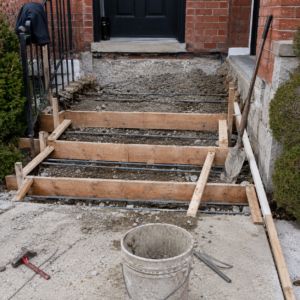
- Removing the existing damaged steps.
- Excavating weak or unstable base material.
- Preparing a stronger base.
- Improving drainage around the entrance.
- Rebuilding the steps, landing, or porch area.
- Correcting uneven rise and run where possible.
- Connecting the steps properly to the walkway or entrance surface.
- Considering concrete, interlocking, stone, or related entrance finishes, depending on the home.
If the entrance connects to pavers, patios, walkways, or hardscaping, Otto’s interlocking brick and pavers Toronto page may be relevant, as base preparation, drainage, and stable walking surfaces are important around the entire entrance, not just the steps.
Cost Factors: Why One Quote May Be Higher Than Another
Concrete step repair and replacement costs can vary because contractors may be pricing very different scopes of work. A low repair price may only cover surface patching, while a higher quote may include removal, preparation, drainage correction, rebuilding, and cleanup.
Cost can be affected by:
- The number of steps involved.
- The depth and spread of cracking.
- Whether the steps are stable or moving.
- Access to the work area.
- Whether old concrete must be removed.
- Whether the base needs correction.
- Drainage or grading problems near the entrance.
- Whether the landing, walkway, or porch also needs work.
- Material choice and finish.
- Cleanup and disposal requirements.
When comparing estimates, ask what is included and what is not. A repair quote should explain how the damaged area will be prepared. A replacement quote should explain whether the base, drainage, landing, and surrounding surfaces are included.
Homeowner Decision Guide: Repair or Replace?
The easiest way to decide is to compare the severity of the damage with the condition of the step structure. Repair is usually best for stable, localized damage. Replacement is usually best for unsafe, moving, or deeply deteriorated steps.
Choose repair when:
- The steps are stable.
- Damage is mostly surface-level.
- Cracks are narrow or moderate.
- Only a few edges need rebuilding.
- Drainage problems are small and correctable.
- The repair will improve safety without hiding movement.
Choose replacement when:
- The steps are sinking, tilting, or separating.
- Cracks are wide, deep, or spreading.
- Several steps are uneven or unsafe.
- Concrete is crumbling across large areas.
- Previous repairs keep failing.
- The base below the steps is unstable.
- The entrance needs a new layout or drainage correction.
Get an inspection when:
- You are not sure whether the steps are moving.
- Water pools after every rain.
- Cracks are getting worse after winter.
- The steps are used daily and feel unsafe.
- The entrance connects to a porch, walkway, foundation, or basement stairwell with visible damage.
What Homeowners Can Safely Check Themselves
Homeowners can safely check concrete steps from ground level and normal walking positions. The goal is to understand the condition before requesting an estimate, not to pull apart concrete or test unstable sections.
Check these items:
- Walk the steps slowly and notice any unevenness or wobbles.
- Look for cracks that are widening or collecting water.
- Check whether edges are chipped, loose, or crumbling.
- Look for water pooling after rain or snowmelt.
- Check whether downspouts or gutters send water toward the steps.
- Look at the connection between the steps, landing, walkway, porch, and home.
- Check whether old patches are lifting or breaking away.
- Take photos after winter and compare them with those taken after heavy rain.
Do not hammer loose concrete, grind cracks, lift settled slabs, or apply coatings over wet or crumbling concrete without understanding the cause. If the steps feel unsafe, limit use where possible until they are assessed.
When to Call a Mason
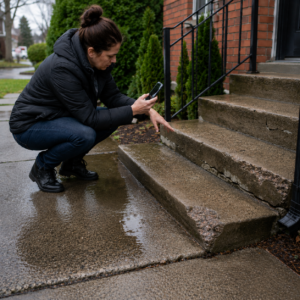
You should call a mason when concrete steps have spreading cracks, loose edges, uneven surfaces, water pooling, old failed patches, settlement, or separation from nearby surfaces. These signs suggest the issue may involve more than simple surface wear.
Call sooner if the entrance is used daily, if the steps are part of the main entry, if ice forms repeatedly in winter, or if children, older adults, guests, or delivery workers use the steps often. Step repair is not only about appearance. It is also about safe access.
Otto’s Masonry provides masonry services in Toronto, including concrete repair, concrete steps, porches, walkways, interlocking, stone masonry, parging, retaining walls, and basement waterproofing. If the step issue is tied to drainage or foundation moisture, Otto’s basement waterproofing Toronto page may also help homeowners understand the water-control side of the problem.
FAQs About Concrete Step Repair vs Replacement in Toronto
When should concrete steps be repaired instead of replaced?
Concrete steps may be repaired when the damage is minor, stable, and mostly limited to cracks, chipped edges, surface wear, or small isolated areas. The steps should not be sinking, tilting, or separating from the home.
When should concrete steps be replaced?
Concrete steps should be replaced when they are sinking, tilting, severely cracked, severely crumbling, pulling away from the home, unsafe to walk on, or failing due to base movement.
Can cracked concrete steps be resurfaced?
Cracked concrete steps can sometimes be resurfaced if the structure is stable and the damage is mostly surface-level. Resurfacing is not a good fix when the steps are moving, hollow, badly cracked, or settling.
Why do concrete step repairs fail?
Concrete step repairs often fail when loose material is not removed, the step is still moving, water keeps entering, drainage is poor, or the original concrete is too weak to hold the repair.
Is replacement always better than repair?
No. Replacement is not always necessary if the steps are stable and the damage is limited. Repair may be the better choice for minor cracks, chipped edges, and surface wear when the cause can be corrected.
Should concrete steps be repaired before winter?
Open cracks, chipped edges, and water-holding areas should be checked before winter, as freeze-thaw cycles can worsen the damage. Repair before winter may help when the steps are still stable.
Can drainage problems decide whether steps need replacement?
Yes. If poor drainage has caused settlement, water pooling, or base movement, replacement or deeper repair may be needed. If drainage is minor and correctable, targeted repair may still work.
Final Answer
Concrete step repair may be enough when the damage is stable, limited, and mostly surface-level. Replacement is usually the better choice when the steps are sinking, tilting, separating, deeply cracked, badly crumbling, or unsafe for daily use.
For Toronto homeowners, the most important factor is the cause. If the problem is only a small crack or chipped edge, repair may work. If drainage, freeze-thaw damage, settlement, or base failure is active, replacing or rebuilding the steps may be the safer long-term decision.