
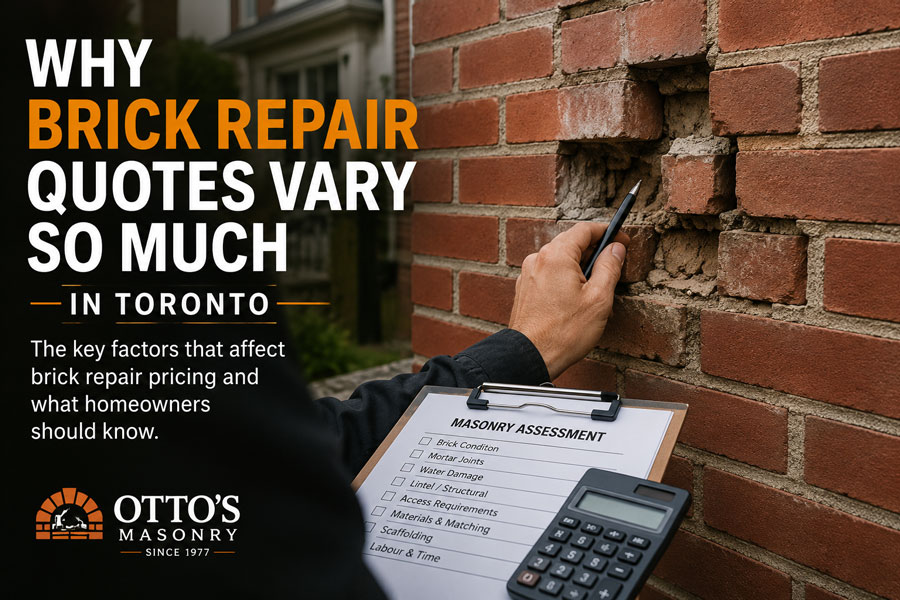
Why Brick Repair Quotes Vary So Much in Toronto
If you have contacted several masonry contractors about damaged brickwork, you may have received brick repair quotes that vary considerably.
That does not necessarily mean one contractor is overcharging or another is offering a bargain. Brick repair is rarely priced by simply counting damaged bricks. The final cost depends on the cause of the damage, the condition of the surrounding wall, access requirements, material availability and the amount of work needed to complete a lasting repair.
Two walls that look similar in a photograph can require completely different repair methods once they are inspected properly.
At Otto’s Masonry, we believe homeowners should understand what goes into a brick repair quote and why the cheapest option is not always the best value.
Brick Repair Is Not a One-Price-Fits-All Service
Brick damage can range from a few deteriorated mortar joints to serious structural movement affecting a large section of wall.
A simple repair might involve replacing several damaged bricks at ground level. A more complex project may require scaffolding, custom brick matching, lintel replacement, rebuilding or correcting the source of water penetration.
The visible damage is often only part of the story.
Before providing an accurate quote, a masonry contractor should determine:
- What caused the damage
- How far the damage extends
- Whether the surrounding bricks are stable
- Whether water is entering the wall
- Whether structural movement is involved
- Whether previous repairs have failed
- What materials are required
- How the repair area can be accessed safely
This is why responsible brick repair pricing usually requires more than a quick glance at a photograph.
- The Number of Damaged Bricks
The number of bricks that need to be removed and replaced is one of the most obvious pricing factors, but it is not always straightforward.
A wall may appear to have five damaged bricks, while closer inspection reveals that neighbouring bricks have also begun to deteriorate.
When brick faces are flaking, crumbling or falling away, the damage may extend deeper into the wall. Removing one damaged brick may expose additional weakened masonry behind or beside it.
The contractor must also consider whether individual bricks can be replaced safely without disturbing the surrounding area.
- The Location of the Damage
Brick repairs at ground level are generally easier to access than repairs several storeys above the ground.
Damage may be located:
- Above windows or doors
- Near the roofline
- On a chimney
- Between neighbouring homes
- Above a porch or garage
- In a narrow side passage
- Behind landscaping or fencing
Difficult access can increase the amount of labour, equipment and safety preparation required.
A small repair high on a chimney may cost more than a larger repair at ground level because of the access involved.
- Scaffolding and Safety Requirements
Some brick repairs can be completed using ladders or small platforms. Others require full scaffolding or specialized access equipment.
Scaffolding may be needed when:
- Repairs are high above the ground
- The work area is large
- The mason needs both hands free for detailed work
- Heavy materials must be moved safely
- The repair is near a roof edge
- The wall is difficult to reach
Scaffolding adds setup time, labour, transportation and equipment costs, but it also allows the work to be completed safely and properly.
Trying to avoid necessary access equipment can lead to rushed or poorly finished repairs.
- The Type and Availability of the Brick
Matching replacement bricks can be one of the most challenging parts of repairing older Toronto homes.
Bricks vary in:
- Size
- Colour
- Texture
- Shape
- Density
- Manufacturing method
- Age
- Weathering
Many older bricks are no longer manufactured. In some cases, suitable replacements must be sourced from specialty suppliers or salvaged materials.
Even when a replacement brick looks close in a sample, it may appear noticeably different once installed across a larger section of wall.
A good brick match considers more than colour. The brick must also be compatible with the existing wall.
- Mortar Colour and Mortar Type
Mortar is just as important as the brick itself.
The wrong mortar can make a repair stand out immediately. More importantly, mortar that is too hard or unsuitable for older brick can contribute to future damage.
Older Toronto homes often contain softer brick and traditional mortar. Using a modern, overly hard mortar may prevent natural moisture movement and place additional stress on the bricks.
Matching mortar may require consideration of:
- Colour
- Aggregate
- Joint profile
- Strength
- Breathability
- Existing wall conditions
A proper mortar match takes time, knowledge and experience.
- The Cause of the Brick Damage
Replacing damaged bricks without correcting the cause of the problem can result in the same damage returning.
Brick deterioration may be caused by:
- Water penetration
- Freeze-thaw cycles
- Failed mortar joints
- Damaged flashing
- Chimney crown failure
- Roof or gutter problems
- Rusting steel lintels
- Foundation movement
- Poor drainage
- Incompatible previous repairs
- Trapped moisture
- Structural movement
A quote that includes diagnosing and correcting the underlying problem may be higher than a quote that only covers the visible damage.
However, repairing the cause is usually far less expensive than repeating the same repair later.
- Lintel Damage Above Windows and Doors
Cracks above windows and doors are not always caused by ordinary mortar deterioration.
Many Toronto homes have steel lintels supporting the brickwork above openings. When these lintels rust, the steel expands and begins pushing the masonry upward and outward.
This may cause:
- Horizontal cracks
- Stair-step cracks
- Bulging bricks
- Displaced mortar joints
- Loose masonry above the opening
Replacing a few cracked bricks will not solve a failed lintel.
If the lintel needs repair or replacement, the project becomes more complex because the surrounding brickwork must be removed, supported and rebuilt correctly.
- Bulging or Bowed Brick Walls
A bulging wall is very different from a wall with a few damaged bricks.
Brick walls can bow or bulge because of:
- Failed wall ties
- Water damage
- Movement behind the brick
- Corroded anchors
- Structural shifting
- Long-term freeze-thaw damage
In these situations, repointing or replacing individual bricks may not be enough.
The contractor may need to remove and rebuild part of the wall or address problems behind the visible brickwork.
Quotes can vary significantly depending on whether the contractor identifies the structural issue or only prices the surface damage.
- Previous Repairs
Poorly completed repairs can make future masonry work more difficult.
Previous repairs may involve:
- Mortar that is too hard
- Incorrect brick sizes
- Poor colour matching
- Surface patching
- Mortar applied over deteriorated joints
- Sealants trapping moisture
- Bricks installed without proper bonding
- Improperly repaired cracks
Before new work can begin, defective materials may need to be removed carefully.
Repairing a failed previous repair often takes longer than working on original masonry.
- Water Damage Behind the Brick
Water can enter a masonry wall through damaged mortar, failed flashing, open joints, roof problems or cracks around windows and doors.
The visible brick damage may be limited, while the moisture problem behind the wall is much larger.
Signs of hidden moisture may include:
- Efflorescence
- Damp interior walls
- Peeling paint
- Musty odours
- Repeated brick spalling
- Deteriorating mortar
- Water stains
- Damage beneath windows
A thorough contractor will look for the source of the moisture instead of simply replacing the damaged bricks.
- Chimney Brick Repair
Chimney repairs are often more expensive than similar repairs on a ground-level wall.
Chimneys are exposed to:
- Rain
- Snow
- Wind
- Freeze-thaw cycles
- Heat
- Condensation
- Flue moisture
Damage may involve the bricks, mortar joints, chimney crown, cap or flashing.
Because chimneys are difficult to access and often deteriorate from the inside out, the visible damage may underestimate the amount of work required.
A chimney may need localized repairs, partial rebuilding or complete rebuilding depending on its condition.
- Small Repairs Still Have Setup Costs
Homeowners are sometimes surprised that replacing only a few bricks can still carry a noticeable cost.
Even a small repair may involve:
- Travel
- Material sourcing
- Brick matching
- Mortar preparation
- Dust control
- Site protection
- Equipment setup
- Safe access
- Cleanup
- Disposal
A contractor must complete these steps whether the project involves five bricks or fifty.
This is why small repairs do not always have a simple per-brick price.
Can Brick Repair Be Quoted From Photos?
Photos can be helpful for an initial review, especially when they clearly show the location and extent of the damage.
However, photographs may not reveal:
- Wall movement
- Loose surrounding bricks
- Hidden water damage
- Failed lintels
- Deterioration behind the surface
- Access limitations
- Mortar condition
- The true depth of damaged joints
A photo may allow a contractor to provide a rough indication of the work involved, but an accurate quote often requires an on-site inspection.
Why the Lowest Brick Repair Quote May Not Be the Best
A lower quote may cover only the visible damage.
A more complete quote may include:
- Removing deteriorated materials
- Correcting the source of the damage
- Matching the brick properly
- Using compatible mortar
- Protecting the surrounding wall
- Safe access equipment
- Detailed cleanup
- Rebuilding unstable sections
- A workmanship guarantee
Before comparing quotes, homeowners should confirm that each contractor is quoting the same scope of work.
A low price is not a bargain if the repair fails after the next Toronto winter.
Questions to Ask When Comparing Brick Repair Quotes
Before choosing a contractor, ask:
- What caused the brick damage?
- Does the quote address the cause or only the visible damage?
- How will the replacement bricks be matched?
- What type of mortar will be used?
- Is scaffolding included?
- Are damaged bricks being replaced or only patched?
- Will surrounding bricks be inspected?
- Is cleanup and disposal included?
- Are there possible additional costs?
- Is the work covered by a workmanship guarantee?
Clear answers make it easier to compare quotes fairly.
What Should a Proper Brick Repair Quote Include?
A detailed brick repair quote should explain:
- The location of the repair
- The approximate repair area
- The work being completed
- Materials being used
- Access requirements
- Whether scaffolding is required
- Whether bricks are being replaced
- Whether mortar joints are being repaired
- Cleanup and disposal
- Any exclusions or possible additional work
The clearer the scope, the easier it is to understand what you are paying for.
Experience Matters With Older Toronto Homes
Toronto has many Victorian, Edwardian and pre-war brick homes. These buildings often require a more careful repair approach than newer construction.
Older bricks may be softer, irregular in size and difficult to match. Traditional mortar may also behave differently from modern cement-based products.
A contractor experienced with older masonry will consider:
- The original brick
- Existing mortar strength
- Moisture movement
- Historic joint profiles
- Replacement material compatibility
- The appearance of the finished repair
The objective should not be simply to make the wall look repaired. The goal should be to preserve the masonry and help the repair blend naturally with the original home.
Request a Brick Repair Assessment
Brick repair quotes vary because brick damage varies.
The most reliable way to determine the proper repair is to inspect the wall, identify the cause of the damage and understand the condition of the surrounding masonry.
Otto’s Masonry has provided brick repair and masonry restoration services in Toronto since 1977. Our team works on older brick homes, chimneys, mortar joints, concrete, stone and other exterior masonry.
If you have cracked, crumbling, loose or deteriorating bricks, contact Otto’s Masonry to request a consultation.
Frequently Asked Questions
How much does brick repair cost in Toronto?
Brick repair costs depend on the number of damaged bricks, wall height, access, scaffolding, brick matching, mortar type and the cause of the damage. An inspection is usually required before an accurate quote can be provided.
Why do brick repair quotes vary between contractors?
Quotes may include different scopes of work. One contractor may price only the visible damage, while another may include scaffolding, brick matching, mortar removal, lintel repair or correction of the underlying moisture problem.
Can a mason quote brick repair from a photograph?
Photographs can help with an initial assessment, but they may not reveal hidden water damage, structural movement, failed lintels or loose surrounding bricks. An on-site inspection is often needed.
Is brick repair priced per brick?
Some localized repairs may be estimated partly by the number of bricks, but labour, access, material sourcing, mortar matching and setup costs also affect the final price.
Should damaged bricks be patched or replaced?
Surface patching may provide only a temporary cosmetic improvement. Bricks that are badly cracked, spalling or deteriorated usually need to be removed and replaced.
Why is chimney brick repair more expensive?
Chimney repairs often require scaffolding or specialized access. Chimneys are also exposed to severe weather, moisture and temperature changes, and the damage may extend beyond what is visible.
Can the wrong mortar damage older bricks?
Yes. Mortar that is harder than the surrounding brick can restrict moisture movement and transfer stress into the bricks, which may contribute to cracking or spalling.