

If you are looking for masonry and brickwork contractors in Toronto that offer free estimates, the better question is not just who will come out for free. It is who will give you a useful estimate that actually helps you understand the wall, the damage, the repair options, and the likely scope of work. A free estimate is valuable when it gives you clarity. It is not very useful when it is only a fast number with little explanation behind it.
For homeowners in Toronto, East York, North York, Rosedale, Forest Hill, The Annex, Etobicoke, The Beaches, and Scarborough, a free estimate is often the first step in deciding whether the problem is small, urgent, cosmetic, structural, or already spreading. That matters because brick and masonry issues often look simpler from the ground than they really are. A loose brick may point to failing mortar. A stained wall may also have moisture problems. A chimney quote may end up involving rebuilding rather than a small repair.
The strongest contractors use the estimate to explain what is actually happening and what your options are. The weaker ones often use the estimate only as a sales tool. That is why homeowners should not compare only whether an estimate is free. They should compare how helpful, specific, and credible it is.
What a free masonry estimate should actually include
A strong free estimate should do more than confirm that brickwork is damaged. It should explain what part of the masonry is failing, whether the issue is isolated or wider, what type of service is likely needed, and what factors could affect the final cost. In Toronto homes, that often means discussing brick condition, mortar loss, chimney exposure, lower wall moisture, access, and the visibility of the finished repair.
Depending on the project, the estimate may point toward brick repair, brick replacement, tuckpointing, brick restoration, chimney repair, or another related masonry service. The important thing is that the contractor can explain why they recommend that direction rather than just naming a service and moving on.
A good estimate should also leave you better informed than you were before. Even if you do not book immediately, you should come away knowing whether the issue can wait, whether it should be addressed before winter, whether it is mostly cosmetic, or whether it is already affecting the home’s long-term condition.
Why free estimates matter more than homeowners think
Many masonry projects begin with uncertainty. The homeowner sees cracked mortar, missing joints, loose brick, chimney wear, or visible staining, but does not know whether the problem is minor or expensive. A free estimate is often the first chance to replace guesswork with a real explanation.
This matters because masonry repairs often become more expensive when they are delayed. A wall that needs small-scale repointing today may need brick replacement later if moisture keeps getting in. A chimney that only needs targeted correction now may move closer to rebuilding after another harsh winter. An estimate helps you decide whether now is the right time to act or whether the condition can be monitored for a while.
Free estimates are also useful because they make contractor comparison more practical. Without one, homeowners often end up comparing websites, not the actual scope. With one, you can compare how each contractor reads the wall, what they think caused the damage, and whether they are recommending a solution that makes sense.
Common masonry problems homeowners ask for free estimates for
Cracked or spalling brick walls
Many estimate requests start with visible brick damage. Homeowners notice cracking, flaking, or missing corners and want to know whether the wall needs repair or replacement. The answer often depends on how much of the surrounding wall is still sound.
Failing mortar joints
Mortar that is recessed, cracked, sandy, or missing is one of the most common reasons people request a masonry estimate. In many homes, this points to a repointing or tuckpointing scope rather than full wall replacement, but only if it is caught early enough.
Chimney wear and upper-wall deterioration
Chimneys are exposed on all sides and often show damage faster than lower wall sections. A free estimate helps homeowners understand whether the chimney needs restoration, rebuilding, or immediate safety attention.
Lower wall and foundation-adjacent masonry issues
At grade level, walls take on splashback, salt, snow, and moisture. That often raises questions about whether the issue is limited to the visible brickwork or extends to parging, foundation coating, or waterproofing concerns.
Porch, step, and entry masonry damage
Homeowners also ask for estimates when visible front-entry masonry starts to crack, sink, separate, or look unsafe. These projects may overlap with steps, porches, or related concrete and hardscape work.
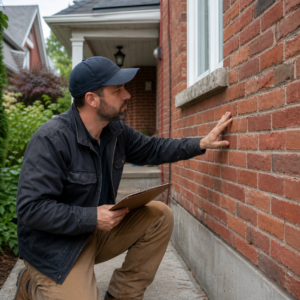
Step-by-step: how a good masonry estimate should work
Initial contact and project description
The first step is usually describing what you have noticed. That may include cracked brick, open mortar joints, a leaning chimney, visible water staining, or a front wall that appears to be failing. Photos can help, but they rarely tell the whole story.
Inspection and condition review
During the estimate, the contractor should assess the visible condition of the masonry, look at surrounding areas that may be affected, and explain whether the problem appears isolated or part of a larger pattern. For older Toronto homes, this may also include discussing previous repairs or mismatched materials already visible on the wall.
Scope explanation and next-step guidance
After the inspection, the contractor should explain what type of service is recommended, what factors may affect the final price, and whether the issue is urgent or can be scheduled more flexibly. This is where a good estimate becomes genuinely useful rather than merely transactional.
What separates a helpful free estimate from a weak one
A helpful estimate is specific. It tells you what part of the wall is affected, what the contractor thinks is causing the damage, and what level of repair is likely appropriate. It also makes room for uncertainty where needed. Good contractors know that some masonry conditions only become fully clear once damaged material is opened up, and they explain that honestly.
A weak estimate usually feels rushed. The contractor may provide a quick number without discussing the surrounding masonry, mortar, exposure level, or whether the visible damage suggests something bigger. In masonry, that is a problem, because price without diagnosis is often just guesswork in disguise.
Another good sign is whether the contractor seems comfortable answering follow-up questions. If you ask why the wall needs restoration instead of a patch, or why the chimney may need partial rebuilding instead of repointing, a credible contractor should be able to explain the logic in plain language.
Why the cheapest quote is not always the best value
The lowest estimate often looks appealing because homeowners are already worried about cost. The problem is that a low number may reflect a smaller scope, weaker prep, less material matching, or a repair plan that focuses only on the most visible area. That can make the estimate look affordable while leaving the actual problem only partly addressed.
Good value usually comes from a contractor who recommends the right amount of work, not the least. If the wall needs repointing across a wider area, a tiny patch is not really a bargain. If the chimney needs rebuilding above the roofline, a smaller cosmetic fix may only delay the real cost.
This matters even more in older Toronto homes, where visible repairs need stronger material matching and better judgment. A cheap repair that looks obvious from the street can lower the visual quality of the whole façade while also failing sooner than expected.
Local factors in Toronto that affect masonry estimates
Toronto’s freeze-thaw conditions are one of the biggest reasons masonry problems worsen over time. Once water gets into mortar joints and brick surfaces, freezing temperatures can accelerate cracking, spalling, and separation. The National Research Council Canada has published work on moisture content and freeze-thaw behaviour in masonry materials, which helps explain why early repair often matters so much in Canadian conditions. You can review that here: NRC Canada masonry freeze-thaw resource.
Toronto’s Property Standards chapter also requires exterior walls, chimneys, steps, walks, and related structures to be maintained in good repair. That is relevant because many estimate requests involve issues that are not just aesthetic. They may already affect safety, moisture performance, or long-term durability. You can review that here: City of Toronto Property Standards.
If the home is heritage-designated, exterior masonry work may also need to account for the City’s heritage permit process. That can affect timing and project planning, especially on visible front façades and chimneys. You can review that here: City of Toronto Heritage Permit Guide.
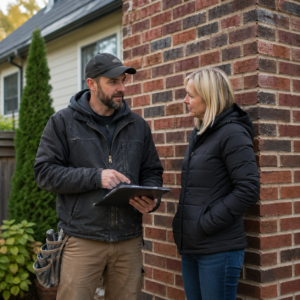
Key questions homeowners ask about free estimates
Do all good masonry contractors offer free estimates?
Many do, but what matters more is whether the estimate is actually useful. A free estimate should give you enough information to understand the likely problem and the recommended direction.
Can I compare contractors just by price?
Not safely. In masonry, price only makes sense when the scope is clear. Two estimates may be far apart because they are pricing very different levels of repair.
Should I get more than one estimate?
Usually, yes, especially if the project is large, highly visible, or the recommendations are very different. Multiple estimates help you compare diagnoses as well as pricing.
What if one contractor says I need a rebuild, and another says I only need repair?
That is a good reason to ask both of them to explain their reasoning more clearly. In masonry, the better explanation usually tells you more than the lower number.
Can an estimate reveal issues I did not notice?
Yes. That is one of the main reasons estimates are valuable. A contractor may notice mortar loss, moisture exposure, or structural patterns that are not obvious from the ground.
Should I wait if the estimate says the issue is not urgent?
Sometimes, but it depends on the wall and the season. Toronto winter exposure can make delayed masonry work more expensive if the problem is already allowing moisture in.
What to expect when you contact us
- You tell us what masonry or brickwork issue you have noticed.
- We arrange an inspection or estimate.
- We assess the masonry and explain what type of work is likely needed.
- We provide a clear quote and recommended scope.
- We help you determine the next step based on the home’s condition.
When you are ready to discuss the next step, contact us.
Which masonry and brickwork contractors in Toronto offer free estimates?
The right contractors to consider are the ones who use a free estimate to give you real clarity, not just a number. If you want help understanding whether your wall needs repair, restoration, tuckpointing, chimney work, or a larger scope, the best next step is to compare contractors based on diagnosis, scope explanation, and local masonry judgment, not just whether the estimate costs nothing.