

Quick Answer
A retaining wall may be starting to fail if it is leaning, bulging, cracking, separating, losing soil from behind, holding water, or showing loose stones, bricks, blocks, or caps. In Toronto, heavy rain, snowmelt, clay-heavy soil, poor drainage, and freeze-thaw cycles can increase pressure behind retaining walls. Homeowners should take early movement seriously because a small lean or crack can turn into a larger structural and drainage problem if the cause is not corrected.
A retaining wall does more than shape a yard. It holds back soil, supports grade changes, manages water, protects outdoor spaces, and can affect nearby steps, walkways, driveways, fences, gardens, and even foundation areas. When a wall starts to fail, the early signs are often easy to miss because they may look like normal aging.
A small crack, slight lean, damp wall face, or sunken area behind the wall may not seem urgent at first. The problem is that retaining walls usually fail because pressure is building behind them. That pressure may come from trapped water, poor drainage, heavy saturated soil, frost movement, tree roots, weak base preparation, or wall construction that is no longer handling the load.
This guide explains the signs a retaining wall is starting to fail, why those signs matter for Toronto homes, what homeowners can safely check, and when it is time to call a mason before the wall becomes unsafe or more expensive to repair.
Why Retaining Wall Failure Matters in Toronto
Retaining wall failure matters in Toronto because local properties often deal with sloped yards, tight side yards, older landscaping, clay-heavy soils, heavy rain, snowmelt, freeze-thaw cycles, and limited drainage space between neighbouring homes. These conditions can increase pressure behind a wall and make small problems worse over time.
A wall may look like a simple garden or landscape feature, but it may be holding back a raised yard, walkway, driveway edge, patio, garden bed, basement entrance, or boundary area. Once the wall begins to move, it can affect the soil and surfaces around it.
The City of Toronto Property Standards bylaw includes requirements related to retaining walls, grading, drainage, and property maintenance. For larger wall projects, homeowners should also be aware that the City of Toronto lists retaining walls under its designated structures permit guidance. If a wall is tall, close to a public area, near a driveway, beside a neighbouring property, or showing movement, it is wise to ask whether a permit or an engineering review may be required.
Common Signs a Retaining Wall Is Starting to Fail
The most common signs of retaining wall failure are leaning, bulging, cracking, separation, drainage problems, soil washout, and movement in nearby surfaces. One small sign may not mean immediate danger, but several signs together usually mean the wall needs attention.
Watch for these warning signs:
- A wall that leans outward or downhill.
- Bulging or bowed wall sections.
- Horizontal, stair-step, vertical, or widening cracks.
- Loose bricks, blocks, stones, caps, or mortar joints.
- Gaps between the wall and the soil behind it.
- Soil washing out through the wall or around the base.
- Water pooling behind the wall after rain or snowmelt.
- Damp staining, moss, or wet streaks on the wall face.
- Blocked or missing weep holes.
- Sunken patios, steps, pavers, or walkways near the wall.
- Fence posts, railings, or garden edges are shifting near the wall.
- Damage that looks worse after winter.
A retaining wall should look stable and reasonably straight for its design. If the wall is changing shape, losing material, or pushing outward, the issue should not be treated as only cosmetic.
Sign 1: The Wall Is Leaning Outward
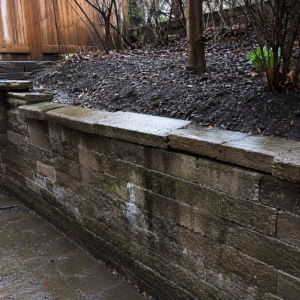
A leaning retaining wall is one of the clearest signs that the pressure behind it may be too high. The top of the wall may tilt forward, or the entire wall may appear to rotate away from the soil it is holding back.
Leaning often happens when water builds up behind the wall, the base shifts, soil pressure increases, or the wall was not built with enough strength or drainage for the site. In Toronto, freeze-thaw cycles can worsen this because trapped water expands when it freezes, pushing wall sections outward.
Homeowners can check for leaning from a safe distance by looking along the wall. If the top of the wall is no longer aligned with the base, or if the lean appears worse than before, the wall should be inspected. Do not push, pull, dig behind, or remove pieces from a leaning wall.
Sign 2: The Wall Is Bulging or Bowing
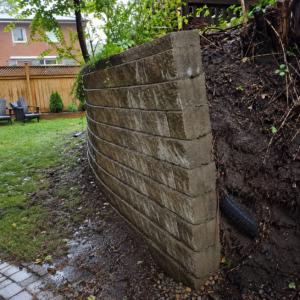
Bulging or bowing means one section of the wall is being pushed outward more than the rest. This often points to pressure behind the wall, usually from trapped water, soil movement, frost action, or poor backfill.
A bulge may appear as a rounded outward curve, a section that sticks out, or one part of the wall that no longer lines up with nearby sections. On masonry retaining walls, bulging may also appear with cracked mortar joints, separated stones, tilted blocks, or loose caps.
Bulging is important because it often means the wall is actively responding to pressure. If the pressure remains, the bulge can grow, cracks can widen, and the wall may eventually need partial or full rebuilding.
Sign 3: Cracks Are Spreading or Changing
Cracks can be an early warning sign when they widen, spread, repeat after repairs, or appear in patterns that suggest movement. Not every hairline crack means failure, but active cracks should be watched closely.
Cracks are more concerning when they are:
- Wider than before.
- Running horizontally along the wall.
- Stair-stepping through mortar joints.
- Opening near corners or wall ends.
- Connected to bulging or leaning.
- Appearing after heavy rain, snowmelt, or winter.
- Returning after patch repairs.
Cracks caused by pressure behind the wall should be filled not only at the surface. If drainage, base movement, or soil pressure is still active, the crack is likely to return.
Sign 4: Soil Is Washing Out From Behind or Under the Wall
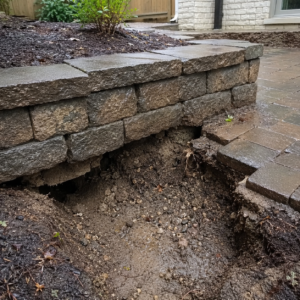
Soil washout can mean water is moving through the wall system too aggressively or carrying soil away from areas that support the wall. This can weaken the wall from behind or below.
Warning signs include gaps behind the wall, holes forming near the top, sand or soil appearing at the wall face, sunken areas behind the wall, and loose soil near the base. Nearby steps, patios, garden beds, or pavers may also start to settle.
Soil washout is not only a drainage issue. It can become a stability issue if the wall loses support. If the wall backs up a raised yard, walkway, driveway, or property line, the washout should be checked quickly.
Sign 5: Water Is Pooling Behind the Wall
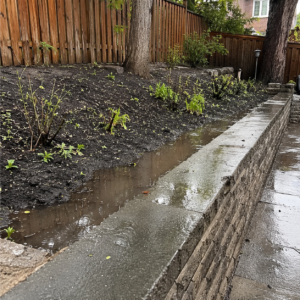
Water pooling behind the wall is a major warning sign because saturated soil becomes heavier and exerts greater pressure. A retaining wall should have a way for water to drain rather than sit behind it.
Pooling may occur due to poor grading, clogged drainage stone, a missing drain pipe, blocked weep holes, roof runoff, or soil that holds water too long. Toronto yards with clay-heavy soil may be especially slow to dry after rain or snowmelt.
The City of Toronto’s basement flooding guidance identifies poor grading, drainage problems, overflowing eavestroughs, and leaking or plugged downspouts as common water concerns around homes. Those same water patterns can also affect retaining walls, lower masonry, foundations, and nearby hardscaping.
If water keeps collecting behind the retaining wall, patching cracks or resetting a few stones may not solve the real problem. The drainage path needs to be understood.
Sign 6: Weep Holes Are Blocked or Missing
Blocked or missing weep holes can allow water pressure to build behind masonry retaining walls. Weep holes are small openings that let water escape through the wall face.
When weep holes are blocked by soil, roots, debris, mortar, mineral buildup, or past repairs, the wall may stay wet, and pressure can increase. If the wall has no visible drainage outlets and shows damp staining, water pooling, or bulging, drainage may be a concern.
Homeowners can visually check weep holes from ground level, but should avoid digging into the wall or forcing tools into openings. The issue may not be only the visible hole. The drainage stone or pipe behind the wall may also be clogged or missing.
Sign 7: Loose Stones, Bricks, Blocks, Caps, or Mortar
Loose masonry is a warning sign because retaining walls rely on stable materials and proper alignment. A few loose capstones may be a minor repair, but loose wall units, open joints, or shifting sections can indicate deeper movement.
Loose materials may appear after winter, heavy rain, root movement, poor drainage, or repeated freeze-thaw cycles. If stones, bricks, or blocks are moving out of place, the wall may be losing support or being pushed by pressure from behind.
For masonry walls, repointing or replacing individual pieces may help when the wall is otherwise stable. But if loose masonry is combined with leaning, bulging, drainage problems, or soil washout, the repair should consider the whole wall system.
Sign 8: Nearby Steps, Pavers, or Walkways Are Settling
Settlement near a retaining wall can indicate that soil is moving, washing out, or losing support. The wall may not be the only visible problem.
Watch for sunken pavers, tilted steps, gaps beside the wall, uneven patio stones, cracked concrete edges, or dips in the soil near the top of the wall. These signs can suggest that water is moving soil away or that the retained area is shifting.
If the wall is connected to patio areas, walkways, garden steps, or driveway edges, drainage should be reviewed as part of the repair. Otto’s Masonry’s interlocking Toronto page is relevant when pavers, patios, steps, and other outdoor masonry surfaces are affected by base movement or poor drainage.
Why Retaining Walls Start to Fail
Retaining walls usually fail when pressure, drainage, base support, materials, or site conditions no longer work together. A visible crack or lean is often only the symptom.
Common causes include:
- Poor drainage: Water builds up behind the wall, increasing pressure.
- Weak base preparation: The wall settles or shifts because the base was not stable enough.
- Clay-heavy or saturated soil: Soil retains water and exerts greater pressure against the wall.
- Freeze-thaw movement: Trapped water freezes, expands, and moves masonry or block sections.
- Tree roots: Roots can shift soil, lift materials, or block drainage paths.
- Downspout discharge: Roof water directed behind or near the wall overloads the area.
- Wall height or design issues: The wall may not be strong enough to support the load it carries.
- Age and past repairs: Older walls may have weakened mortar, worn stone, damaged blocks, or hidden patchwork.
The City of Toronto’s lot grading requirements highlight the importance of positive drainage patterns and directing water toward suitable outlets. While that page is written for specific building situations, the practical lesson applies to retaining walls as well: water should not be trapped where it creates pressure or directs moisture toward structures.
Repair Options for a Failing Retaining Wall
The right repair depends on how far the retaining wall has moved, what caused the failure, and whether the drainage system can still work. A small crack and a leaning wall are not the same repair.
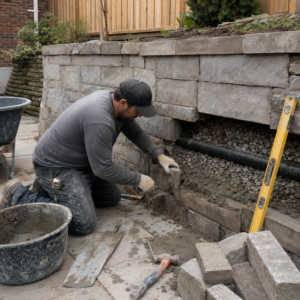
Possible repair options include:
- Drainage correction: Redirecting water, improving grading, clearing outlets, or adding drainage where suitable.
- Weep hole repair: Clearing or restoring drainage openings in masonry retaining walls.
- Repointing: Repairing open mortar joints on a stable masonry wall.
- Resetting loose stones or caps: Useful when movement is limited, and the wall structure is still sound.
- Replacing damaged masonry units: Needed when bricks, stones, or blocks have cracked, shifted, or deteriorated.
- Partial rebuilding: Used when one section has failed but the rest of the wall remains stable.
- Full rebuilding: Needed when the wall is leaning badly, undersized, poorly drained, or unsafe.
For retaining wall work, Otto’s Masonry’s retaining walls Toronto page is the most relevant service page because retaining walls require careful attention to structural integrity, soil movement, drainage, and long-term performance.
When Repair May Be Enough
Repair may be enough when the wall is still stable, movement is minor, and the cause of the problem can be corrected. The wall should not be heavily leaning, bulging, or losing soil support.
Repair may be suitable when:
- A few capstones, bricks, blocks, or stones are loose.
- Cracks are small and not spreading.
- The wall is still straight and stable.
- Drainage issues are limited and correctable.
- Soil is not washing out behind or below the wall.
- Nearby steps, pavers, or walkways have not settled.
- The problem appeared recently and has not worsened quickly.
For example, a small section with loose capstones and a visible downspout issue may be repaired if the wall has not moved. In that case, the repair may include redirecting runoff and resetting or repointing affected masonry.
When a Larger Fix May Be Needed
A larger fix may be needed when the wall is moving, the drainage system has failed, or the wall can no longer safely hold back soil. A wall that is leaning or bulging should not be treated as a surface repair.
A larger repair may be needed when:
- The wall leans outward.
- Bulging is visible from the front or side.
- Cracks are wide or spreading.
- Soil is washing out from behind or under the wall.
- Water regularly pools behind the wall.
- Steps, pavers, walkways, or driveways near the wall are settling.
- The wall supports a major grade change.
- The wall is near a property line, a public path, a basement entrance, or a driveway.
- Previous patch repairs have failed.
In these situations, the wall may need partial rebuilding, drainage reconstruction, base correction, or full replacement. If the wall is tall or supports a significant load, homeowners should ask whether a permit, engineering review, or designated structure requirements may apply.
What Homeowners Can Safely Check Themselves
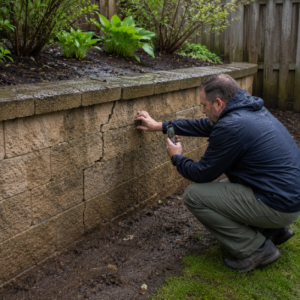
Homeowners can safely inspect a retaining wall from ground level, especially after heavy rain, snowmelt, or winter. The goal is to observe, photograph, and compare changes over time without disturbing the wall.
Check these items:
- Look from the side to see whether the wall leans outward.
- Check the face for bulges, cracks, loose units, and damp stains.
- Look behind the wall for pooling water, soft soil, or gaps.
- Check the base for soil washout or loose material.
- Look for blocked or missing weep holes.
- Check where downspouts and roof runoff discharge.
- Look for settlement in nearby pavers, steps, patios, or walkways.
- Take photos from the same angles every few months or after major storms.
Avoid digging behind a leaning wall, pulling out loose stones, standing below an unstable wall, or trying to force the wall back into place. A retaining wall holds weight, and disturbing it without a plan can make the problem worse.
When to Call a Mason
You should call a mason when a retaining wall shows signs of leaning, bulging, spreading cracks, drainage problems, soil washout, loose masonry, blocked weep holes, or nearby settlement. These are signs that the wall may be under pressure or losing support.
Call sooner if the wall is near a basement entrance, driveway, walkway, public area, property line, or foundation. Also, call sooner if the wall supports a large grade change or if movement appears to be getting worse after rain or winter.
Otto’s Masonry provides masonry services in Toronto, including retaining walls, stone masonry, brick repair, tuckpointing, concrete repair, parging, interlocking, and basement waterproofing. If the retaining wall problem is connected to wet lower areas, foundation moisture, or poor drainage near the home, Otto’s basement waterproofing Toronto page may also help homeowners understand how drainage and foundation protection connect.
FAQs About Failing Retaining Walls
What are the first signs that a retaining wall is failing?
The first signs often include leaning, bulging, cracks, loose stones or blocks, water pooling behind the wall, soil washout, blocked weep holes, and nearby pavers or steps settling.
Is a leaning retaining wall dangerous?
A leaning retaining wall can become dangerous if movement continues or if the wall supports a large amount of soil. It should be inspected, especially if the lean is worsening or the wall is near a walkway, driveway, basement entrance, or property line.
Can a failing retaining wall be repaired?
Sometimes it can be repaired if the movement is minor, the wall is still stable, and the drainage issue can be corrected. If the wall is badly leaning, bulging, or losing soil support, partial or full rebuilding may be needed.
Why do retaining walls fail after winter?
Retaining walls often show more damage after winter because trapped water can freeze and expand behind the wall. This freeze-thaw pressure can worsen cracks, movement, drainage problems, and loose masonry.
Does poor drainage cause retaining wall failure?
Yes. Poor drainage is one of the main causes of retaining wall failure. Water buildup makes the soil heavier and increases pressure behind the wall, which can lead to leaning, bulging, cracking, and soil washout.
Should I patch cracks in a retaining wall?
Patching may help only if the wall is stable and the crack is minor. If the crack is caused by drainage pressure, leaning, or soil movement, patching the surface without fixing the cause will not be a lasting repair.
When should I call a mason for a retaining wall?
Call a mason when the wall leans, bulges, cracks, loses soil, has loose masonry, stays wet, has blocked drainage, or affects nearby steps, patios, walkways, driveways, or foundation areas.
Final Answer
The main signs a retaining wall is starting to fail are leaning, bulging, spreading cracks, loose masonry, soil washout, water pooling, blocked drainage, and settlement near the wall. In Toronto, these issues often become worse after heavy rain, snowmelt, and freeze-thaw cycles.
The practical step is to look for movement and water pressure, not just surface damage. A small stable repair may be enough for minor issues, but a leaning, bulging, or soil-washed wall should be inspected before it becomes unsafe or more costly to rebuild.