

Quick Answer
Retaining wall drainage problems often show up as leaning walls, bulging sections, water pooling behind the wall, soil washout, cracks, loose stones, or wet areas that never dry properly. In Toronto, rain, snowmelt, clay-heavy soil, freeze-thaw cycles, and poor grading can put extra pressure behind retaining walls. Homeowners should watch for drainage issues early because trapped water is one of the most common reasons retaining walls shift, crack, or fail.
A retaining wall is not only a landscape feature. It holds back soil, manages grade changes, supports outdoor spaces, and helps direct water around the property. When drainage behind the wall works properly, water can move away rather than build up pressure behind the structure. When drainage fails, the wall may start to lean, crack, bulge, separate, or push outward.
For Toronto homeowners, this matters because many properties have sloped yards, older masonry, tight side yards, clay-heavy soil, basement moisture concerns, and repeated freeze-thaw conditions. A wall that looks fine in summer may start showing movement after a wet fall, heavy snowfall, spring thaw, or repeated rain.
This guide explains the retaining wall drainage problems Toronto homeowners should watch for, why they happen, what warning signs matter, what can be checked safely, and when a mason should inspect the wall before the damage gets worse.
Why Retaining Wall Drainage Matters in Toronto
Retaining wall drainage matters because water adds pressure behind the wall. A retaining wall is already holding back soil. When water collects in that soil, the load increases, the pressure rises, and the wall has to work harder than it was meant to.
Toronto homes often deal with rain, melting snow, roof runoff, driveway runoff, clay soil, poor grading, and limited drainage space between neighbouring properties. These conditions can send water toward retaining walls, foundation walls, basement entrances, garden beds, steps, and lower patio areas.
The City of Toronto Property Standards bylaw includes requirements related to landscaping, drainage, grading, and retaining walls. The practical takeaway for homeowners is simple: walls and drainage around a property should not be ignored when they become unsafe, unstable, or water-damaged.
For new construction, larger work, or walls that may affect safety or neighbouring properties, permits and code requirements may also matter. The City of Toronto provides guidance on designated structures, including retaining walls, while Ontario’s Building Code sets out rules for certain retaining walls based on exposed height and location. Homeowners do not need to become code experts, but they should ask questions when a wall is tall, close to a building, beside public property, near a driveway, or showing movement.
Common Signs of Retaining Wall Drainage Problems
Drainage problems usually show up as movement, moisture, soil displacement, or repeated damage. The wall may not fail all at once. Often, it gives small warnings first.
Toronto homeowners should watch for:
- Water pooling behind the retaining wall after rain or snowmelt.
- A wall that leans outward or appears to tilt downhill.
- Bulging or bowed wall sections.
- Cracks in masonry, stone, concrete, brick, or block.
- Loose stones, bricks, or blocks.
- Soil washing out from behind or under the wall.
- Wet soil that stays saturated long after rain stops.
- Water stains, moss, algae, or damp streaks on the wall face.
- Blocked or missing weep holes.
- Sunken patio stones, steps, or walkways near the wall.
- Gaps are forming between the wall and nearby soil, steps, or paving.
- Damage that worsens after winter or heavy rain.
One small damp spot does not always mean the wall is failing. But a combination of water pooling, leaning, cracking, soil washout, and recurring movement should be taken seriously. Those signs usually mean water is not draining properly from behind or around the wall.
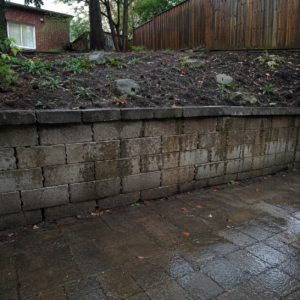
Why Water Behind a Retaining Wall Is a Problem
Water behind a retaining wall is a problem because it increases pressure against the wall. Soil is already heavy. Saturated soil is heavier and exerts greater pressure.
When water cannot drain, several things can happen:
- The wall may lean forward as pressure builds behind it.
- Mortar joints, stonework, brickwork, or block joints may crack.
- Soil may wash out through weak points.
- Freeze-thaw cycles may expand trapped water, worsening movement.
- Nearby steps, walkways, patios, or driveways may settle.
- Water may move toward the foundation or basement area.
- The wall may eventually need partial or full rebuilding.
This is why drainage should be part of the wall’s structure, not an afterthought. A retaining wall needs a stable base, suitable backfill, a way for water to move, and proper grading around the area. If those parts are missing or blocked, even a good-looking wall can fail earlier than expected.
What Causes Retaining Wall Drainage Problems?
Retaining wall drainage problems usually happen when water has no clear path to escape. Poor backfill, clogged weep holes, missing drain pipe, bad grading, roof runoff, soil pressure, and freeze-thaw movement can all contribute.
Common causes include:
- No drainage layer behind the wall: Soil packed directly behind the wall can hold water and increase pressure.
- Missing or clogged weep holes: Weep holes allow water to escape through the wall face. If blocked, pressure builds behind the wall.
- No drain pipe: Some walls need a perforated pipe behind the base to move water away from the wall.
- Poor grading: Soil or paving that slopes toward the wall sends water where it should not go.
- Clay-heavy soil: Clay can retain water longer and build up more pressure behind a wall.
- Roof and downspout runoff: Water discharged near the wall can overload the drainage system.
- Tree roots and garden beds: Changes in roots and soil can affect drainage and wall movement over time.
- Freeze-thaw cycles: Water behind the wall can freeze, expand, and push masonry or block sections outward.
- Poor past repairs: Patching cracks without solving drainage can hide the issue for a short time while pressure continues to build.
The City of Toronto’s lot grading guidance explains the importance of maintaining positive drainage patterns and draining side yards toward suitable outlets. While that guidance is written for specific building-permit contexts, the homeowner lesson still applies: water should be directed away in a controlled manner, not trapped behind walls or pushed toward foundations.
Drainage Problem 1: Water Pooling Behind the Wall
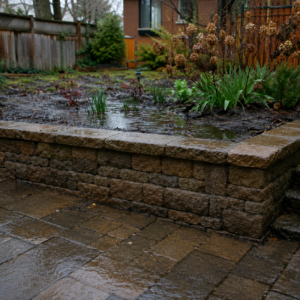
Water pooling behind the wall is one of the clearest signs that drainage is not working. After rain or snowmelt, the soil behind the wall should not remain soggy for long.
Pooling may occur because the backfill holds too much water, the wall lacks a drainage pipe, the weep holes are blocked, or the grading directs water toward the wall. In some Toronto yards, narrow side yards and older hardscaping make the problem worse because water has fewer places to go.
Watch for soft soil, standing water, muddy areas, or wet spots that remain days after rain. If water repeatedly sits behind the wall, pressure may build slowly until the wall starts to lean, crack, or bow outward.
Drainage Problem 2: Leaning or Bulging Wall Sections
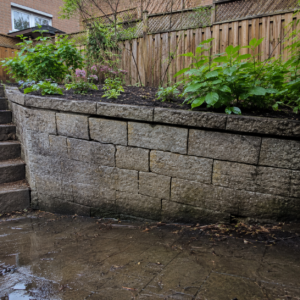
A leaning or bulging retaining wall often means pressure is building behind it. Water is not always the only cause, but poor drainage is one of the most common reasons walls move forward.
Leaning can show up as a wall that tilts outward at the top. Bulging can appear as one section pushing forward while the rest of the wall stays straight. Both signs suggest the wall is under stress.
Toronto freeze-thaw cycles can make this worse. Water trapped behind the wall freezes and expands, then thaws, leaving gaps. Over time, repeated pressure can cause the wall to become misaligned.
Do not ignore a leaning wall, especially if it is near a walkway, driveway, basement entrance, property line, or public space. Movement usually means the wall needs inspection, not just a surface repair.
Drainage Problem 3: Soil Washout and Settlement
Soil washout happens when water carries soil away from behind, below, or beside the retaining wall. This can weaken the wall base and cause nearby surfaces to settle.
Signs of soil washout include:
- Gaps behind the top of the wall.
- Sunken soil, patios, steps, or walkways near the wall.
- Fine soil or sand appears on the wall face.
- Holes forming behind the wall.
- Loose stones or blocks near the base.
- Water trails cut through the soil after rain.
Soil washout can become a safety issue because the wall may lose support from behind or below. If the wall supports a raised yard, garden bed, driveway edge, or walkway, settlement should be checked sooner rather than later.
Drainage Problem 4: Blocked Weep Holes
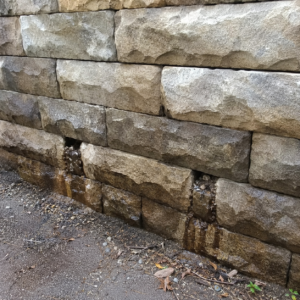
Blocked weep holes can stop water from escaping through the wall face. Weep holes are small openings that allow trapped water to drain out rather than build pressure behind the wall.
Weep holes can become blocked by soil, roots, debris, mineral buildup, insects, mortar, or poor past repairs. Some walls were also built without enough weep holes or without the right drainage layer behind them.
If you see water stains above or around weep holes, damp wall faces, or no drainage after heavy rain, the openings may be blocked, or the drainage system behind the wall may not be working. Homeowners can visually inspect them from the ground, but they should avoid poking them deeply or damaging the wall without knowing how it was built.
Drainage Problem 5: Downspouts and Roof Runoff Directed Toward the Wall
Downspouts and roof runoff can overload a retaining wall drainage system when water is discharged too close to the wall. Even a well-built wall can struggle if roof water is constantly sent behind it.
Check whether downspouts drain into the soil behind the wall, toward the wall base, or onto a sloped patio that sends water to the retaining wall. Also, look for overflowing gutters during storms.
The City of Toronto’s basement flooding guidance identifies overflowing eavestroughs, leaking or plugged downspouts, poor lot grading, and foundation cracks as common water concerns around homes. These same water patterns can also affect retaining walls, lower brickwork, parging, and nearby masonry features.
Drainage Problem 6: Cracks, Loose Masonry, and Open Joints
Cracks and loose masonry can be signs that drainage pressure is stressing the wall. In masonry retaining walls, cracks may appear in mortar joints, stone joints, brickwork, blocks, caps, or corners.
Cracks caused by drainage pressure may widen over time. Loose stones or bricks may shift after heavy rain or winter. Caps may separate or tilt. Once water enters these openings, freeze-thaw cycles can worsen the damage.
If the retaining wall is made of brick, stone, block, or concrete, the repair should consider both the visible damage and the pressure behind the wall. Repointing a crack without improving drainage may not hold if water continues to push from behind.
For walls with damaged masonry, Otto’s Masonry’s retaining walls Toronto page is the most relevant service page because retaining wall construction and repair need to account for structure, soil movement, drainage, and long-term performance.
Repair Options for Retaining Wall Drainage Problems
Repair options depend on the wall type, height, condition, movement, drainage setup, and what the wall is holding back. Some issues can be corrected with drainage improvements, while others need partial or full rebuilding.
Possible repair options include:
- Clearing drainage outlets: Useful when weep holes or visible openings are blocked.
- Improving grading: Helps direct surface water away from the wall.
- Extending downspouts: Prevents roof runoff from soaking the soil behind the wall.
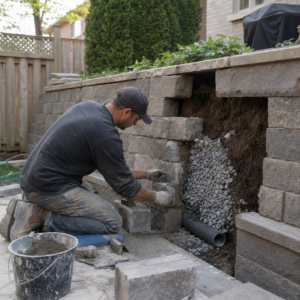
- Adding or repairing drainage pipe: Helps move water away from the wall base.
- Replacing poor backfill: Drainage stone may be needed behind the wall, rather than water-holding soil.
- Repointing open joints: Useful for stable masonry walls with localized joint failure.
- Replacing loose or damaged stones, bricks, or blocks: Needed when units are no longer secure.
- Partial rebuilding: Needed when one section is failing but the rest of the wall is stable.
- Full rebuilding: Needed when the wall is leaning, bulging, undersized, poorly drained, or unsafe.
Drainage repairs should not only improve the wall’s appearance. They should reduce pressure behind the wall. That is the difference between a repair that hides symptoms and a repair that addresses the cause.
When a Small Repair May Be Enough
A small repair may be enough when the wall is stable and the drainage problem is limited. The key is that the wall should not be leaning, bulging, cracking widely, or losing soil support.
A smaller repair may work when:
- Only one drainage outlet is blocked.
- The wall is straight and stable.
- Only a few joints or stones are loose.
- Water is coming from an obvious downspout or grading issue.
- The damage is recent and not spreading.
- There is no major settlement behind or below the wall.
For example, if roof runoff is being discharged behind the wall, extending the downspout and repairing minor joint damage may be enough if the wall has not moved. If a few stones have shifted but the base is sound, targeted masonry repair may be possible.
When a Larger Fix May Be Needed
A larger fix may be needed when the wall has moved, soil is washing out, drainage was never properly installed, or the wall is no longer safe. A leaning retaining wall should not be treated as a cosmetic problem.
A larger repair may be needed when:
- The wall leans outward or bulges.
- Cracks are wide or spreading.
- Soil is washing out from behind or under the wall.
- Patios, steps, or walkways beside the wall are sinking.
- The wall supports a driveway, walkway, high-grade change, or public area.
- Water keeps pooling behind the wall after every storm.
- Previous repairs have failed.
- The wall appears too tall or too lightly built for the soil it holds back.
In these cases, the repair may involve rebuilding part or all of the wall, including improved drainage, base preparation, backfill, and wall design. If the wall is tall, close to a structure, or near public property, homeowners should ask whether a permit or engineering review may apply.
What Homeowners Can Safely Check Themselves
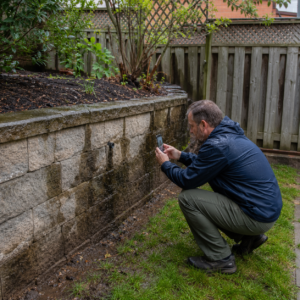
Homeowners can safely check a retaining wall from ground level, especially after rain or snowmelt. The goal is to spot warning signs without digging behind the wall, removing stones, or disturbing unstable sections.
Check these items:
- Look at the wall from the side to see if it leans outward.
- Check for bulging sections, wide cracks, or loose masonry.
- Look for standing water or soggy soil behind the wall.
- Check whether downspouts discharge near or behind the wall.
- Look for blocked weep holes or damp stains on the wall face.
- Check for soil washout, holes, or sunken areas near the wall.
- Look for nearby patios, steps, or walkways that show signs of settlement.
- Take photos after heavy rain and compare them over time.
Do not stand below a wall that appears unstable, do not pull loose stones from the wall, and do not dig behind a leaning wall without professional guidance. A retaining wall holds back weight, and disturbing it can make the situation worse.
When to Call a Mason
You should call a mason when a retaining wall shows leaning, bulging, cracking, loose masonry, soil washout, blocked drainage, repeated pooling, or winter movement. These signs mean the wall may be under pressure from trapped water or shifting soil.
Call sooner if the wall is near a driveway, walkway, basement entrance, property line, steps, or public area. Also, call sooner if the wall supports a major grade change or if water is moving toward the foundation.
Otto’s Masonry provides masonry services in Toronto, including retaining walls, brick repair, tuckpointing, stone masonry, concrete repair, parging, interlocking, and basement waterproofing. If the retaining wall problem is connected to wet lower walls or foundation moisture, Otto’s basement waterproofing Toronto page may also help homeowners understand the drainage and foundation side of the issue.
For outdoor masonry connected to patios, steps, or hardscaping, the interlocking Toronto page is also relevant because poor drainage around interlocking areas can affect retaining walls, steps, driveways, and nearby masonry surfaces.
FAQs About Retaining Wall Drainage Problems
What are the signs of poor retaining wall drainage?
Common signs include water pooling behind the wall, leaning, bulging, cracks, loose stones, soil washout, blocked weep holes, damp wall faces, and nearby patios or steps settling after rain or winter.
Why does poor drainage make a retaining wall fail?
Poor drainage lets water build up behind the wall. Saturated soil is heavier and exerts greater pressure against the wall, which can lead to leaning, cracking, bulging, soil movement, or wall failure over time.
Do retaining walls need weep holes?
Many masonry retaining walls need weep holes or another drainage path so water can escape. Without proper drainage, water pressure can build behind the wall and stress the structure.
Can a leaning retaining wall be repaired?
Sometimes a leaning wall can be repaired if the movement is minor and the structure is still stable. If the wall has major movement, poor drainage, weak base support, or soil washout, partial or full rebuilding may be needed.
Can downspouts cause retaining wall problems?
Yes. Downspouts that drain behind or near a retaining wall can saturate the soil and overload the wall’s drainage system. Redirecting roof runoff may be part of the repair plan.
Should I fix drainage before repairing wall cracks?
In many cases, yes. If drainage is causing pressure behind the wall, patching cracks without fixing water flow may only hide the problem for a short time.
When should I call a mason for a retaining wall?
Call a mason when the wall leans, bulges, cracks, loses soil, has blocked drainage, shows loose masonry, or stays wet after rain. Call sooner if the wall supports a driveway, walkway, public area, or major grade change.
Final Answer
Retaining wall drainage problems usually come from trapped water, poor grading, blocked weep holes, missing drain systems, roof runoff, soil washout, or freeze-thaw pressure. Toronto homeowners should watch for leaning, bulging, cracks, wet soil, loose masonry, and settlement near the wall.
The practical answer is to fix the water problem before patching the wall. If drainage pressure is still active, cracks and movement often return. A stable wall with a small drainage issue may only need targeted repair, but a leaning, bulging, or soil-washed wall should be inspected before it becomes unsafe.